
ADHD Time Blindness: A Science-Based System to Make Time Visible
Struggling with ADHD time blindness? Discover a science-based system that makes time visible, improves awareness, and helps you manage your day with clarity and control.
Elias J. Mitchell
10/23/20255 min read


The Science-Based System That Finally Makes Time Visible for ADHD Brains
For most of your life, you’ve been fighting an invisible enemy. It has no shape, no size, no weight, yet it has likely been the source of immense frustration, anxiety, and shame. That enemy is time itself.
For the ADHD brain, time is often like smoke—a formless, fleeting substance that slips through your fingers no matter how tightly you grasp it. You know it’s there, but you can’t feel it. You can’t hold it. You just look up and realize it’s gone.
As an author who has dedicated my career to exploring the intersection of neuroscience and productivity, I’ve seen this struggle up close. We’ve been told to "manage our time better," but how can you manage something you can't even see? The truth is, the failure isn't in your effort; it’s in the approach. You’ve been given generic advice for a very specific, neurological challenge. It’s time for a new, science-based ADHD time system.
The Scientific Diagnosis: Why Time Feels Invisible
The experience of time feeling shapeless and slippery is not a personal failing. It is a well-documented neurological phenomenon known as time blindness. It's a core feature of the ADHD brain's unique operating system.
Due to differences in the prefrontal cortex and the way our brains process neurotransmitters like dopamine, our internal "clock" is inconsistent . We don't have a steady, intuitive sense of time passing. This is not a metaphor; it's a perceptual reality. Trying to manage your life using a faulty internal clock is like trying to navigate the ocean with a compass that spins randomly. It’s a recipe for getting lost.
The Scientific Solution: If You Can't See It, You Can't Manage It
For decades, productivity advice has focused on strengthening your internal sense of time—on "trying harder" to be aware. This is a losing battle. It’s like trying to fix your eyesight by squinting harder instead of just getting a pair of glasses.
The research-backed ADHD time solution is a radical and liberating shift in perspective. Instead of trying to fix your internal perception, you must create an external one. The foundational principle of an effective, evidence-based ADHD time system is this: you must make time visible.
This is the core philosophy I explore in my book, Invisible Hours. The goal is to stop relying on your brain’s inconsistent internal clock and instead build a robust, reliable external system that holds and displays time for you. We need to take the abstract, invisible concept of time and turn it into a concrete, tangible object in our environment.
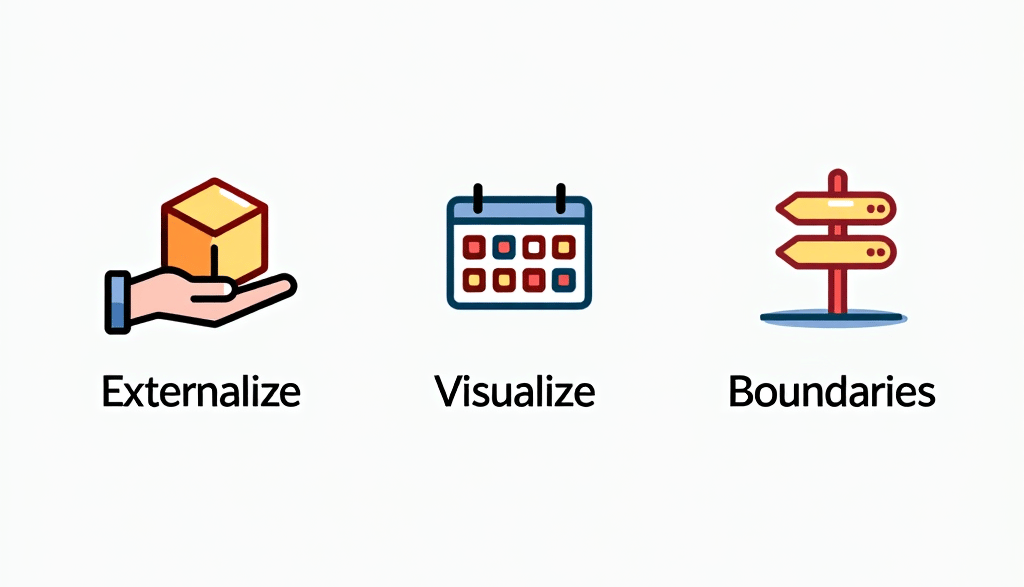
The 3 Pillars of a "Time-Visible" System
So, what does a system that makes time visible for ADHD brains actually look like? It’s not about a single magic app, but a personalized system built on three scientific pillars.
Pillar 1: Externalize Time (Turn It from a Concept into an Object)
The first step is to stop treating time as an idea in your head and start treating it as a physical object. You have to take it out of your mind and put it in your line of sight.
This is the principle of cognitive externalization. The most effective tools for this are visual timers (like the TimeTimer app or a physical sand timer). These devices don't just show you numbers; they show you a visual representation of a block of time that physically shrinks as it passes. This provides a constant, low-effort, ambient awareness of time's passage, acting as a prosthetic for the internal sense you lack.
Pillar 2: Visualize Your Day (Turn It from a List into a Map)
A long, text-based to-do list is often overwhelming for the ADHD brain. It’s a cognitively demanding wall of words with no sense of shape or duration. To make your day visible, you must turn that list into a visual map.
This is where time-blocking on a digital calendar comes in. By assigning every task to a specific, color-coded block of time on your calendar, you transform your day from an abstract list of obligations into a concrete, visual landscape. At a glance, you can see the "shape" of your day, understand the relationships between tasks, and realistically assess what you can and cannot accomplish. This is the essence of scientific time management for ADHD.
Pillar 3: Create Tangible Boundaries (Turn Transitions into Physical Cues)
The transition from one task to another is a high-risk moment for the ADHD brain. It’s easy to get lost in the gap between activities. A time-visible system uses external, physical cues to make these transitions tangible.
This could be a dedicated, unmissable alarm that signals it’s time to stop one task and start another. Even better, it could be an environmental cue. For example, using a smart plug to turn on a specific lamp 15 minutes before you need to leave the house. These external triggers act as a bridge, guiding you from one "place" in your day to the next without relying on your internal clock.
Your Blueprint for an Evidence-Based Time Management System
Building a life where time feels solid, reliable, and on your side is not a fantasy. It’s a construction project. It requires the right blueprints and the right materials. The blueprint is the science of the ADHD brain. The materials are the smart, simple tools that allow you to put that science into practice.
This isn't about finding another "hack." It's about building a sustainable, science-driven time management system that is custom-fit to your brain.


Ready to Stop Fighting Invisible Time and Finally Make It Visible?
This isn't another generic productivity hack; it's a science-based revolution for your ADHD brain. You don't need to try harder; you need a better system based on how your mind actually works.
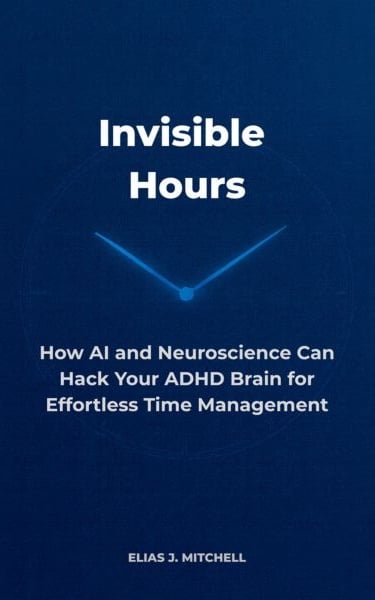
In my book, Invisible Hours: How AI and Neuroscience Can Hack Your ADHD Brain for Effortless Time Management, I provide the complete, evidence-based blueprint for making time tangible and building a life of effortless control.
Elias J. Mitchell writes about time management, productivity, and mindset, blending practical strategies with the smart use of AI to help readers work smarter and live better.